Top Signs You Need Garage Door Service – Don’t Ignore These
The clearest sign you need garage door service is a change in how the door behaves: it needs a second button press, hesitates, shakes, or gets louder than it used to be. Those small shifts rarely fix themselves. They point to a worn component that’s working harder every week. If you’ve started giving the opener a second press because it “sometimes doesn’t catch,” you haven’t adapted to your door. You’ve adapted to a system telling you something is failing. That second press has a cost, and it compounds with every day you ignore it. If you’d rather not sort it out yourself, call (833) 954-3381 and we’ll take a look.
What Are the First Signs a Garage Door Is About to Fail?
The earliest signs are behavioral, not dramatic. Most homeowners in Sheepshead Bay don’t wake up to a broken door. They notice a habit forming over weeks. We’ve learned to ask people what they do differently with the door now compared to a year ago, and the answer is usually the diagnosis.
Here’s the workaround inventory we hear most often, and what each habit points to mechanically:
- “I give it two or three presses.” The opener’s logic board or the safety sensor alignment is drifting, or the motor’s travel limits have slipped. A single press that no longer catches is an electrical signal problem, not a door problem.
- “I hold the button down the whole way.” The safety sensors are misaligned or dirty, or the opener’s force setting has drifted out of range. Holding the button bypasses the auto-reverse, which is exactly the safety feature you don’t want to defeat.
- “I lift the door a little by hand before it moves.” A spring is losing tension or a roller has seized. The opener is strong enough to drag the door partway but not to lift it cleanly.
- “I jiggle the track when it sticks.” A track has been knocked out of alignment or a hinge has loosened. Jiggling works until it stops working, usually mid-lift.
- “I only open it partway to keep the noise down.” Worn rollers, loose hardware, or a lubrication breakdown. The noise is the symptom, not the problem.
Each habit is you compensating for a component. The component gets worse. The habit gets bigger. That’s how a $200 repair quietly becomes a spring replacement in Sheepshead Bay, because nobody called when it was still small.
What Should You Look For on Springs and Cables?
Springs and cables fail without warning, but they almost always show visible clues first. You can check for these from a safe distance, standing on the ground, without touching anything. Never reach for, unwind, or try to adjust a torsion spring or cable yourself. They’re under extreme tension and a single mistake can cause serious injury. What you can do is look.
- A gap in the torsion spring coil. A crisp, straight gap in the spring above the door means the spring has snapped and the door is now being carried by the opener alone. Stop using the door.
- A visibly stretched or angled coil. Torsion springs that have lost tension often sit slightly wider apart or look less even than they should.
- Cables that look slack or badly wound. A cable that’s hanging loose on one side, or bunching on a drum, indicates the door’s load is no longer balanced.
- Cables off their drum. If a cable has jumped its pulley or drum, don’t operate the door. Call for emergency service.
- Fraying or rust streaks along a cable. A worn cable will eventually snap under load.
- Extension springs with a stretched, distorted look. Over time, extension springs lose elasticity and stop holding the door’s weight.
Springs under tension require a trained technician, not a tutorial. In Sheepshead Bay, our technicians have up to 13 years of experience, so we’ve seen every version of “it looked fine until it didn’t.” If anything above sounds familiar, don’t test fate by pressing the button again.
Why Does My Garage Door Sound Different in Winter Than in Summer?
A noisy door in a Sheepshead Bay winter is a different problem from a noisy door in July, and treating them the same wastes money and misses the real cause.
Cold weather contracts metal. The tracks, hinges, and rollers shrink slightly, changing their clearances. Lubricant thickens. A door that was quiet in fall can develop a rattle in winter because the metal has shrunk just enough to loosen hardware that was previously snug. That kind of winter noise is usually a maintenance issue: clean it, lubricate it, tighten the loose bolts, and it quiets down. It’s not a failed component. It’s the door adjusting to colder temperatures.
Summer noise is different. A door that gets noisier in July points to a breakdown: a bearing drying out, a roller cracking, a hinge wearing. Heat expands metal, so clearances usually loosen, but damage doesn’t go away with warmth. A summer rattle is often a symptom of something that’s actually failing.
And a door that’s been noisy all year, in every season, is the loudest signal of all. That’s a chronic wear problem. Whether the door has a Chamberlain, Genie, or older opener, our team can trace the source so you’re not guessing whether it’s the season or the door.
How Do You Test a Garage Door in 60 Seconds?
You can evaluate the door’s health in about a minute without tools. Stand on the ground and watch the door travel up and down once. This is the speed and smoothness test:
- Listen to the rhythm. The door should move at one steady speed. Sputters, surges, or drags at a certain point along the track mean an uneven load, a jammed roller, or a spring that’s no longer doing its share of the lifting.
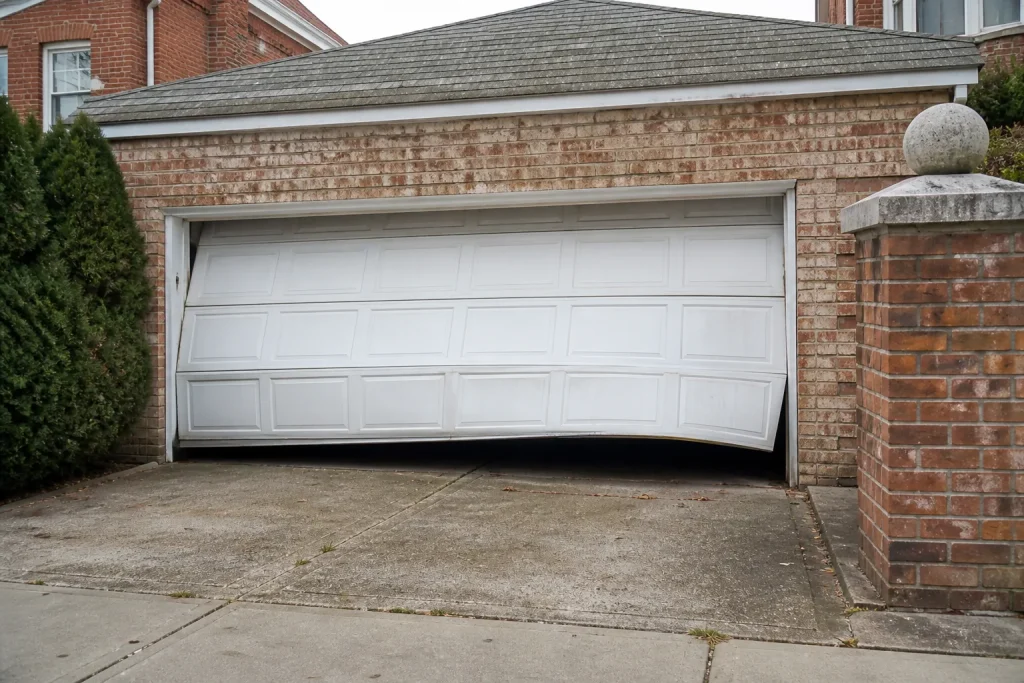
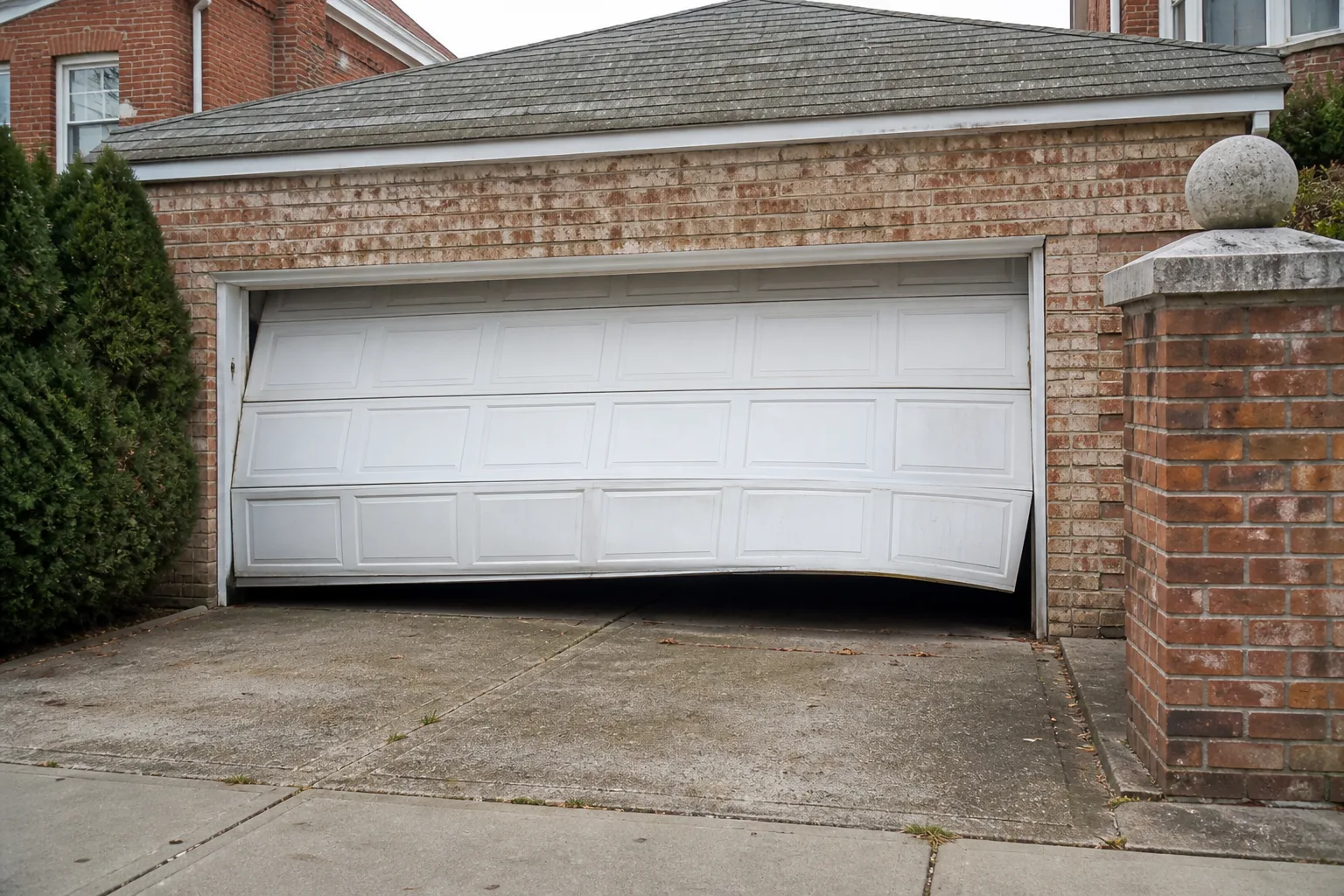
- Watch the gap at the bottom. The door should come down level across the whole width. A visible gap on one side means the door is out of balance or a track has shifted.
- Feel the door by hand (with the opener disconnected, if you know how to pull the release safely). A door that lifts smoothly shouldn’t feel heavy or bind. If it takes real strength to lift, or it won’t hold itself open halfway, the spring is failing.
- Check for shimmy. If the door rocks side to side on its way down, a track, roller, or hinge is out of alignment.
- Watch for hesitation. Any pause at the start or middle of travel is a signal to stop using it and call for garage door repair.
Do this once a month or so, in Sheepshead Bay and everywhere else. It’s the cheapest diagnostic available, and it catches problems while they’re still cheap to fix.
What Does It Mean If the Door Shakes When Closing but Not Opening?
A door that shakes on the way down but travels fine on the way up has an asymmetrical problem. That matters because asymmetric failures get worse faster than symmetric ones, and they’re harder to catch by eye.
Think of the door’s load. When it goes up, the springs are helping, the opener’s motor is unloading, and everything runs in one direction. When it goes down, the springs are winding up, the motor is pushing against gravity, and the tracks, rollers, and hinges are all bearing weight. A track that’s slightly out of vertical alignment can be invisible on the lift and very obvious on the descent. A roller that’s worn on one side can pass fine going up and bind going down. A door that’s off-center will tilt slightly, and the shaking is you watching the door fight gravity unevenly.
We see this most often when one side of the door has been knocked or when the track mounts have loosened unevenly, sometimes after the door hits something or someone bumps the track. The problem tends to start small (“it shudders a bit at the bottom”) and progress (“the door doesn’t quite sit level”). If you notice the door shaking on close, and definitely if it’s been shaking for more than a week, it’s worth a look before the problem spreads to the opener. That’s the kind of early tracking issue that a look at the opener – LiftMaster, Chamberlain, Genie, Craftsman – plus the door itself can catch in one visit.
When Should You Call a Pro Instead of Watching and Waiting?
Call us when the door needs any workaround to operate, when you see a gap in a spring or a cable off its drum, when the door shakes on close, or when the door gets stuck open. A stuck-open door is an open house, and that’s a security problem, not a convenience one.
For snapped springs, dead openers, or a door off its track, we offer dedicated emergency garage door service. We work on your brand, so there’s no “we don’t handle that opener” when you call: LiftMaster, Chamberlain, Genie, Clopay, Amarr, Wayne Dalton, Craftsman, and Raynor are all in scope. Opener repair, spring repair, and a full garage door installation all happen under one call, so repair and replacement decisions don’t sit across multiple trips. Our technicians have up to 13 years of experience, and we quote the price before work starts so the invoice matches the estimate.
Related services in Sheepshead Bay: our garage door opener repair team handles smart and traditional systems on the spot, and you can always reach the main Garage Door Repair Sheepshead Bay team for any question about your door.
The Bottom Line
The signs of a failing garage door are almost never dramatic. They’re the second button press, the habit of holding the button down, the slight shudder on close. Each one maps to a component working harder than it should. Catch them early and you’re usually looking at a repair. Ignore them and you’re waiting for a failure, often at the worst time. If you’re in Sheepshead Bay and need help, Garage Door Repair Sheepshead Bay offers free estimates. Call (833) 954-3381 and we’ll take a look before the small problem becomes a big one.
Frequently Asked Questions
Maintenance handles seasonal noise, lubrication, and tightening; repair handles any changing behavior, visible spring or cable damage, or a door that won’t sit level. If the door needs a workaround to open, it’s repair, not maintenance. Call (833) 954-3381 for a free estimate.
No. Torsion and extension springs are under extreme tension and a mistake can cause serious injury. Spring repair should always be handled by a trained technician with the right tools. Call (833) 954-3381 and we’ll get it fixed safely.
It usually means a track, roller, or hinge is out of alignment on one side, so the door travels unevenly under load on the way down. Asymmetrical problems worsen faster than symmetrical ones. Have it checked before it spreads to the opener; call (833) 954-3381 for a free estimate.
Yes, if the door won’t close fully, especially if it’s stuck open. A door that won’t close leaves the home unsecured. We offer dedicated emergency garage door service for exactly that situation. Call (833) 954-3381 and we’ll get someone out.
Written by the team at Garage Door Repair Sheepshead Bay.
Need Garage Door Help?
Call Garage Door Repair Sheepshead Bay - the local pro we connect you with is licensed and insured, here with fast after-hours help in Sheepshead Bay.
(833) 954-3381